
 English
 Italiano
 Français
 Deutsch
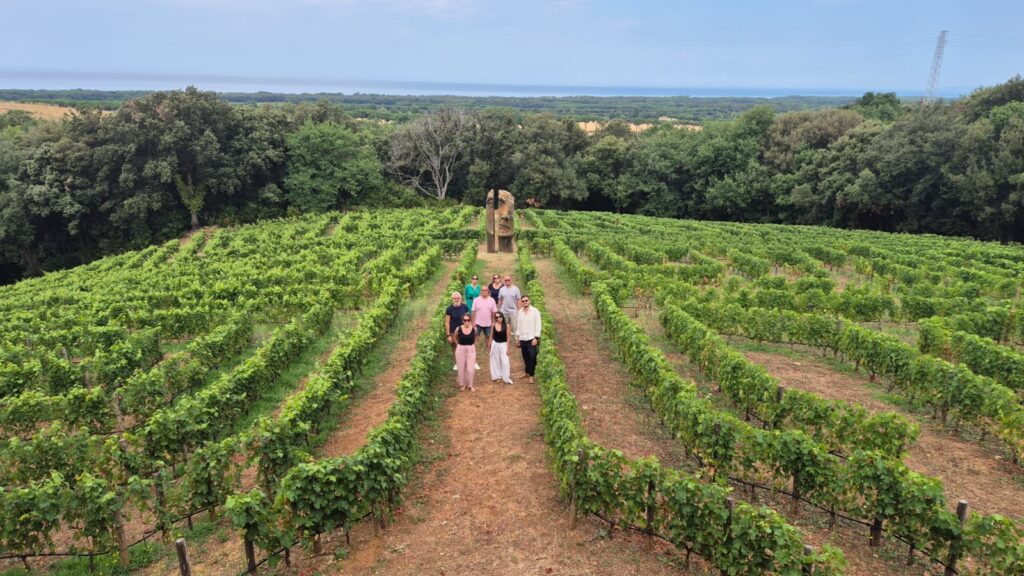

Team, terroir, friends and a lot of good wine
Some journeys begin as work trips and end up becoming something more.
Two full, intense, hot, and at times unpredictable days. Forty-eight hours in Tuscany with the whole Chronos team, between Montalcino, Monte Amiata and Bolgheri. A shared experience, of course, but above all a chance to return to where everything takes shape: the places, the people, and the stories we try to tell every day through the wines we choose.
We left Lugano at 6 in the morning. Coffee, few words, a few still-sleepy faces and one clear direction: Tuscany.
Our first stop took us to Castelnuovo dell’Abate, in the heart of Montalcino’s south-eastern side, at Podere Le Ripi.
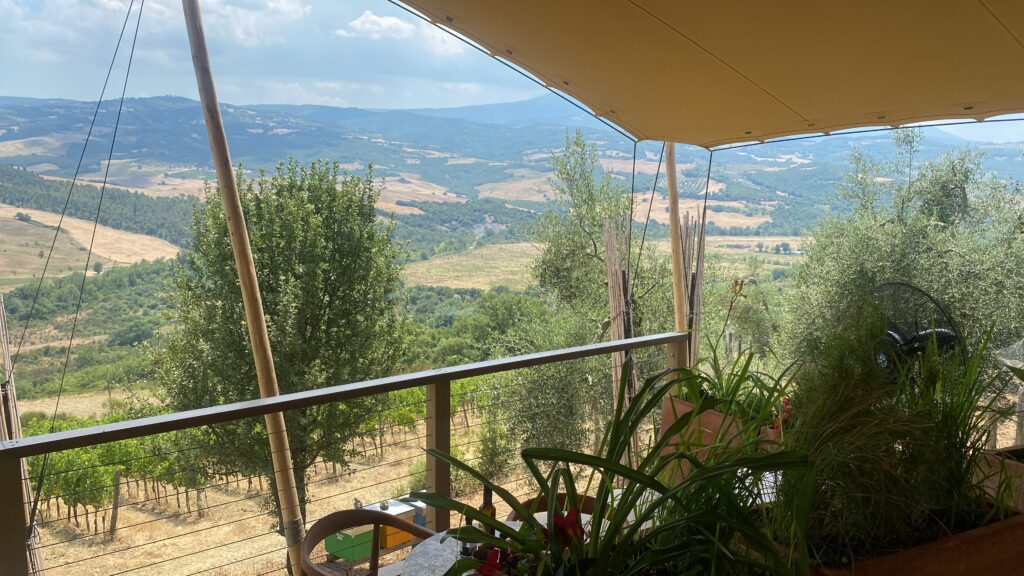
And Castelnuovo dell’Abate is not just any place. For those who know Montalcino, it is one of those names that already says a great deal before a bottle is even opened. A true natural cru of the area, shaped by the protective presence of Monte Amiata, which plays a fundamental role here: sheltering, regulating, cooling, creating temperature shifts and giving this part of Montalcino a wilder, deeper, more vertical character.
It is a landscape of steep vineyards, woods, calanchi, winding roads and constantly changing views. Montalcino here is not just postcard-perfect. It is rougher, more instinctive, more alive.
Waiting for us was Mary Cerini, Export Director of the estate since last year, a true expert on Sangiovese in all its forms and nuances, passionate and deeply professional. She guided us through a detailed tasting of the new vintages.
Outside, the heat was intense, but the wines immediately brought us back into focus. The Brunello wines of Podere Le Ripi speak very clearly of the different souls of Montalcino: different zones, altitudes, soils and exposures that Sebastian and the team are learning to interpret with ever greater precision. These are deep, luminous, never overworked wines, able to bring together energy, elegance and a very clear reading of place.
But perhaps one of the most beautiful things about Podere Le Ripi is that here, nothing is treated as secondary.
From the simplest and most immediate Sangiovese to the Brunello di Montalcino Riserva, the level of care feels the same. There is no “lesser” wine treated as such. Every level of drinking has its own dignity, its own purpose, its own research. And this is especially clear in the Rosso di Montalcino.
The Rosso di Montalcino 2022 is a perfect example. At a time when much of the appellation is already releasing the 2024 vintage, Podere Le Ripi has only just presented the 2022. Not by chance, but by choice. Here, the Rosso is not a fallback wine, not the younger sibling of Brunello to be released as quickly as possible. It is given the time and value it deserves.
The 2022 is a sunny, immediate, generous vintage. And yet in the glass, the wine is never ordinary. It is simple in the most beautiful sense of the word, yet complex. Direct, yet deep. It has that natural quality great wines often have: they do not need to explain themselves too much, because they reach you immediately.
After the Rosso 2021, a wine so essential, precise and almost disarming in how good it was, the 2022 confirms once again how much this project is growing at every level.
Vintage after vintage, Podere Le Ripi seems to have found a constant: it keeps getting better, impressing with honesty, vision and continuity. There is a clear idea behind every wine, a precise direction, a kind of research that does not need to raise its voice to be heard.
Sebastian is doing truly important work here. And you can feel it.
The wine of the day, helped also by the heat? Cappuccetto Rosa 2024. The ultimate rosé for summer. Delicate, refreshing, savoury, immediate in the best possible way. A true tonic drink, one of those bottles that needs no explanation: you open it, share it, and it disappears far too quickly.
Lunch at Serendipity was, as always, perfect in its simplicity. Local cured meats and cheeses, vegetables and fruit from their biodynamic farm, clean and essential flavours, without unnecessary construction. A kind of simplicity that almost unknowingly comes close to perfection.
In the afternoon, after a refreshing swim on Monte Amiata, we were ready for Bakkanali Estivi, in Seggiano.
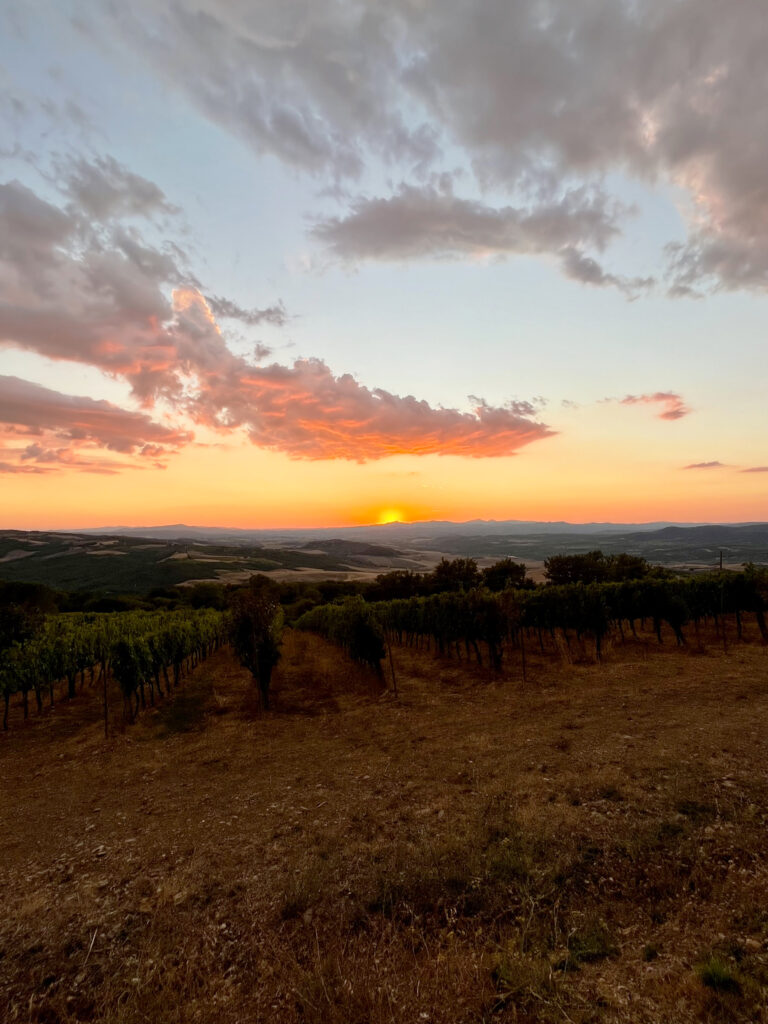
Before the event itself, though, there is Bakkanali as a winery. And perhaps that is where we need to begin in order to truly understand the energy of that evening.
Bakkanali was born in Poggioferro, a hamlet of Seggiano, on the slopes of Monte Amiata. A place that does not resemble the Tuscany most often photographed and told. Here we are not in the classic softness of Montalcino, nor in the ordered precision of Chianti. This is a higher, harsher, more mountainous Tuscany. A mountain Montalcino, one could almost say, even though we are already in another territory, with another soul.
Monte Amiata is an ancient extinct volcano, a huge and silent presence dominating the landscape. It protects, cools, creates temperature shifts, brings wind, snow, altitude. And above all, it completely changes the way the vine lives in this corner of Tuscany. Bakkanali’s vineyards sit between roughly 600 and 800 metres above sea level, in a climatic and geological context that is very different from lower, sunnier Montalcino. Here, the mountain enters the wine.
The soils tell a complex story: calcareous sediments, flysch, volcanic sands, mineral components that change as altitude rises. It is a geologically ancient, layered territory, still relatively unexplored from a winegrowing point of view. And that is precisely the beauty of it. Bakkanali was not created to replicate something that already exists, but to give voice to a new place, or at least to one that has not yet been fully told.
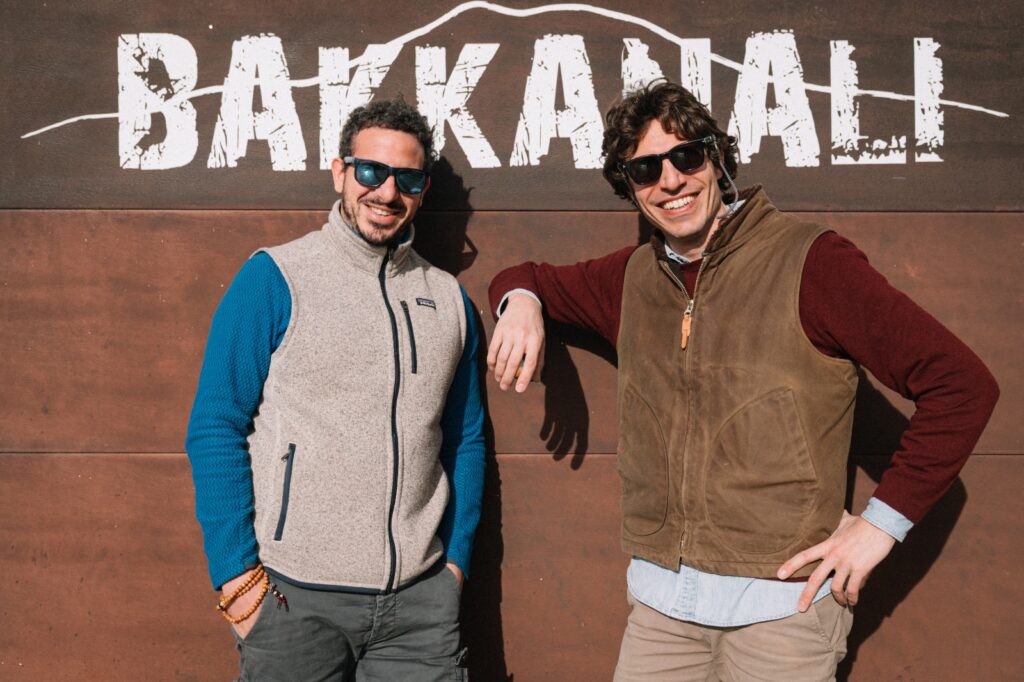
Ugo and Sebastian seem to move with this spirit: curiosity, freedom, instinct, but also real precision. Free from some of the rigidities of appellation rules, they can interpret Monte Amiata with a contemporary sensibility, without losing their connection to the land. In the red wines, you can already feel this tension: fruit, freshness, energy, substance, but always with that higher, more mountain-driven vibration that makes the sip alive and never predictable.
And the feeling is that this is only the beginning.
Around Bakkanali, many projects are already taking shape. New vineyards, new ideas, new readings of the territory. Among them, some white wines we have not yet tasted, but which they described to us with that light in their eyes that usually announces something important. High-altitude vineyards, on soils even more deeply marked by the mountain and by Amiata’s volcanic past. They told us these wines will leave a mark. And knowing the energy behind the project, we are very curious to see if they will.
Bakkanali today has something rare: it feels young, free, almost instinctive, and yet it already has a very strong identity. It is not trying to be “another Montalcino”, nor an alternative version of something we already know. It is trying instead to tell Monte Amiata for what it is: wild, high, mineral, unpredictable, beautiful.
And perhaps that is exactly why their event works so well. Because it comes from a real project, a real place, from people who are not simply organising a party, but building a small world around a precise, free and deeply contemporary idea of wine.
And then there is Hardstyle, Sebastian’s new project, which we tasted again for the second time in just a few days, right during Bakkanali Estivi.
Sebastian is the winemaker and co-owner of both Podere Le Ripi and Bakkanali, and Hardstyle seems to reveal his freer, more creative and more courageous side. Small batches that started almost as experiments, but are taking shape in a truly impressive way: white wines aged sous voile, extended ageing, plenty of research and several editions to come.
We are talking about roughly 580 bottles per batch. A drop in the ocean, of course, but one of those drops that does not go unnoticed. A small liquid laboratory where technique, instinct and freedom meet without too many filters.
The event, organised by Ugo and Sebastian of Bakkanali, has now reached its third edition and over the years has become a small meeting point for wine professionals from different parts of the world. A unique line-up of artisan wineries, all in some way connected to the Bakkanali spirit: producers, friends, people following similar paths even when coming from different territories, backgrounds and stories.
It is a convivial, fun, very alive event. One of those that manages to put some of Italy’s most interesting small wineries under the spotlight today, without losing lightness. Without becoming stiff. Without becoming a “fair”. Here you taste, talk, laugh, listen. And above all, you feel a real community.
The setting is, as always, devastatingly beautiful. The winery clinging to the gentle slopes of Monte Amiata, the open view over Montalcino and the hills of the Val d’Orcia, that Tuscan light that always seems to know exactly what to do.
The only downside: a rather threatening storm moving around Monte Amiata, with lightning on the horizon and a sky straight out of a film. It made everyone a little nervous, but stopped no one. In the end, the Seggiano area was only lightly touched. The party was safe. And perhaps because of that, people were even more charged.
The Chronos team immediately felt at ease. Many friends, many good wines, talented vignerons, new discoveries. In short, the ideal environment for us curious explorers of the wine world.
Monte Amiata stayed with us until late into the night, with the occasional threatening flash of lightning, music, good food, great wines curated by Vineria Aperta, beautiful people and a Tuscany that was welcoming, sincere and always gentle. Whatever the weather, one might say. Actually, perhaps also thanks to the weather.
The following morning, being early risers as we are, we were already back in the car. Destination: the Tuscan coast. Bolgheri, to be precise.
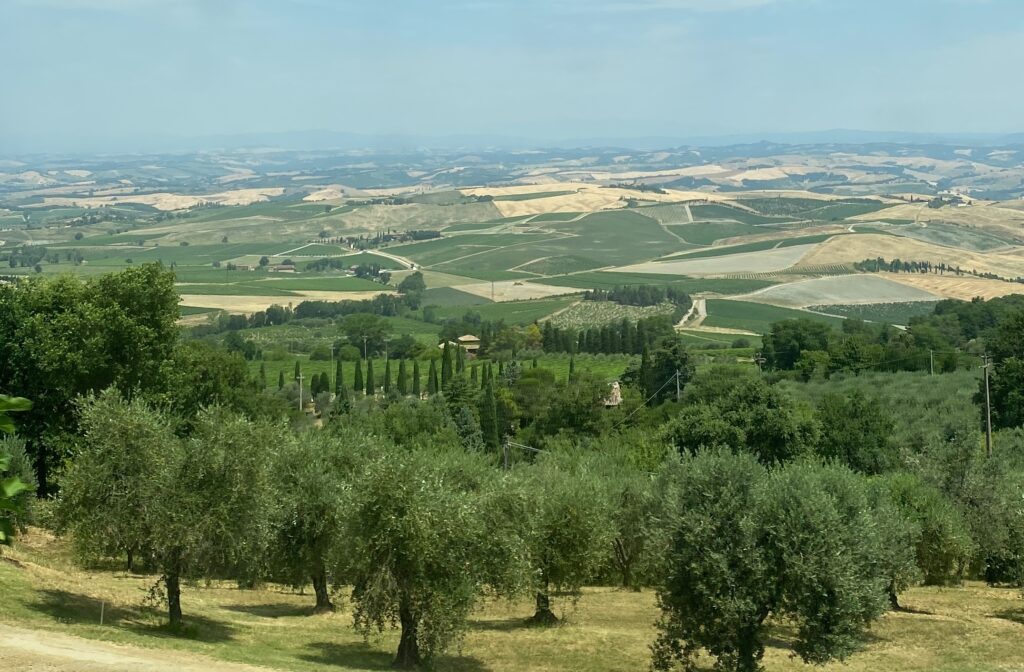
A completely different Tuscany. Still Tuscan at heart, but with a more maritime, more worldly soul, less rustic than the hills of Chianti or Montalcino. Another Maremma, one that never disappoints: wild hills, Mediterranean scrub, roads descending towards the sea and views that, at certain moments, grip your heart.
In Bolgheri, we arrived for the first time with the whole team at Tenuta Fratini, one of Chronos’ most recent collaborations. A project that, if you do not yet know it, you really need to discover.
Welcoming us were Ludovica Fratini, owner of the estate, and Davide D’Alterio, General Manager. Davide is one of those professionals who, when he talks about wine, makes you want to listen. Whether the subject is Tuscany or not, he has a deep, precise, living knowledge. A true wine bible, but without rigidity. Ludovica, for her part, lets a genuine passion emerge, a deep attachment to these places and to the family project she fully feels as her own. You can clearly sense her desire to help write a new page in this story, and throughout the visit she truly made us feel at home.
Tenuta Fratini is located in the southernmost corner of the appellation, where the Colline Metallifere curve towards the sea and form the natural boundary of Bolgheri, between the municipality of Castagneto Carducci and that of San Vincenzo.
The Fratini family is not new to the world of wine. They arrived in Bolgheri in the late 1990s with the creation of Tenuta Argentiera, a project that over the years became one of the important names of the appellation and helped shape the success of Bolgheri as we know it today. In 2016, the family sold Argentiera, but their bond with those places remained extremely strong.
A few years later, Tenuta Fratini was born: a new project built on an enormous and surprising property, over 1,300 hectares in total, from woods to Mediterranean scrub, from rocks to vineyards, from fields down to the plain and then further towards the nature reserve and the beach. It is rare to see so many different landscapes within a single estate.
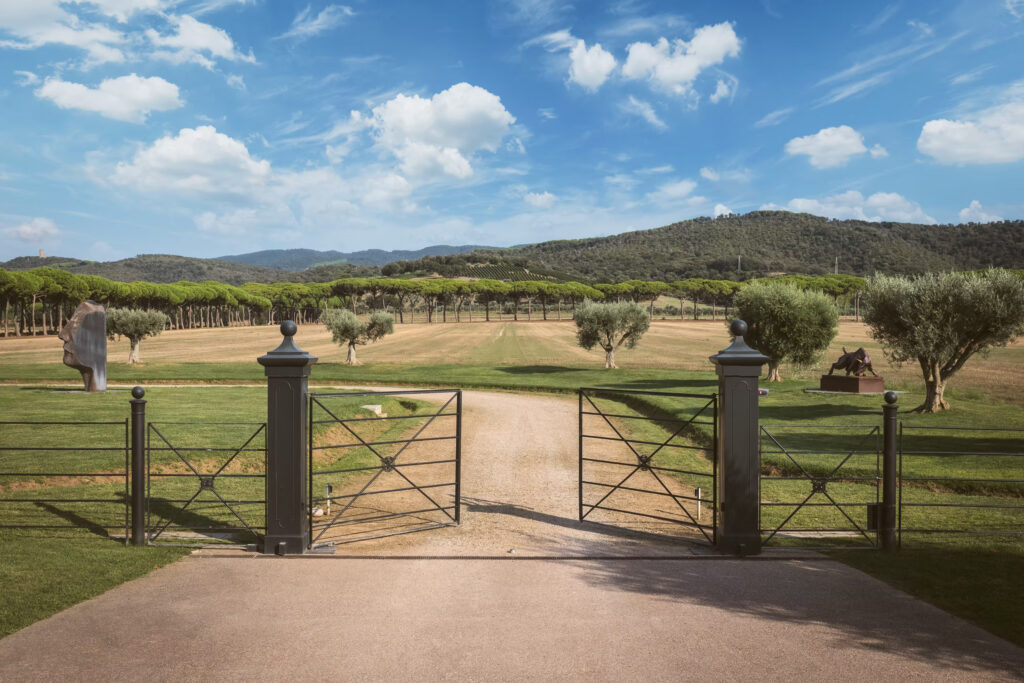
The vineyard heart of the estate is small compared with the overall size of the property: around 14 hectares today, with the aim of reaching 28 in the coming years. And this is precisely where you understand the nature of the project. It is not about planting as much as possible. It is about understanding where it truly makes sense to do so.
Since 2019, a deep study of the territory has been underway. The idea is clear: to analyse more than a thousand hectares in order to identify only the areas most suited to wine production, to understand which soils, exposures, altitudes, slopes and proximities to woods and sea breezes can give rise to something unique.
To do this, the Fratini family brought in Pedro Parra, one of the world’s leading experts in zoning and soil study. Ludovica described his work as a sort of CT scan of the territory, and it is a perfect definition. A study carried out with cutting-edge tools, technologies for analysing the subsoil, core sampling, direct observation, and the reading of structures, depths and compositions. Not a surface-level consultancy, but a true path of knowledge.
Then comes another step that says a lot about the ambition of the project: bringing Eric Boissenot to Bolgheri.
And this is not a detail. Boissenot is one of the most important names in contemporary Bordeaux oenology. He works, among others, with four of the five Premier Cru Classé estates of Bordeaux: Château Latour, Château Lafite-Rothschild, Château Margaux and Château Mouton-Rothschild. We are therefore talking about a knowledge of Bordeaux blending that is not theoretical, but daily, deep, almost familial.
Familial in the literal sense, too. Eric is the son of Jacques Boissenot, a historic figure in Bordeaux oenology, who trained alongside none other than Émile Peynaud, one of the great fathers of modern oenology. It may mean everything or nothing, of course. But in our view, it means something. There are families that have a craft in their blood, and the Boissenots seem to have Bordeaux blending in their veins.
In Bolgheri, however, Eric arrives in a new role. This is not about replicating Bordeaux in Tuscany, and it would be a mistake to think so. The context here is profoundly different: more Mediterranean, sunnier, more maritime, Tuscan to the core. And precisely for this reason, it is fascinating. Tenuta Fratini represents a new ground for him, a different challenge, a place that seems to have deeply inspired him.
The result is a rare meeting point: on one side, the precision, balance and culture of Bordeaux blending; on the other, the substance, light, Mediterranean scrub and energy of Bolgheri. Not a Tuscan Bordeaux, but a possible new reading of Bolgheri, built with the tools, sensitivity and ambition of a great wine.
Alongside Eric Boissenot is Emiliano Falsini, one of the most sought-after Italian oenologists of the moment. The result is a working team built with great ambition, but also with great coherence: soil, vineyard, grape, interpretation. Every step seems designed to create wines capable of telling Bolgheri with a new voice.
And then there is the agronomic management, another fundamental piece. Here too, the estate has chosen to surround itself with leading figures, including Simonit&Sirch, names that have become global references in pruning and vineyard management. Consultants of this level are obviously not an automatic guarantee of a great wine, but they are a clear signal. They speak of the desire to build a solid, serious project, designed for the long term.
The true strength of Tenuta Fratini, however, remains the place.
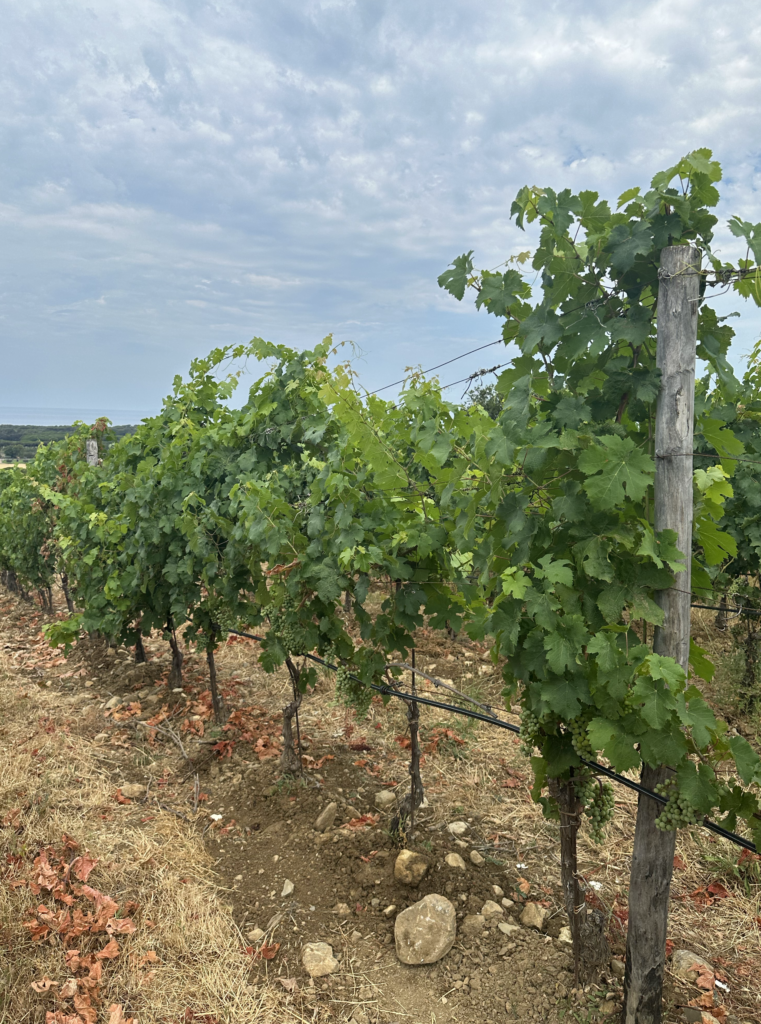
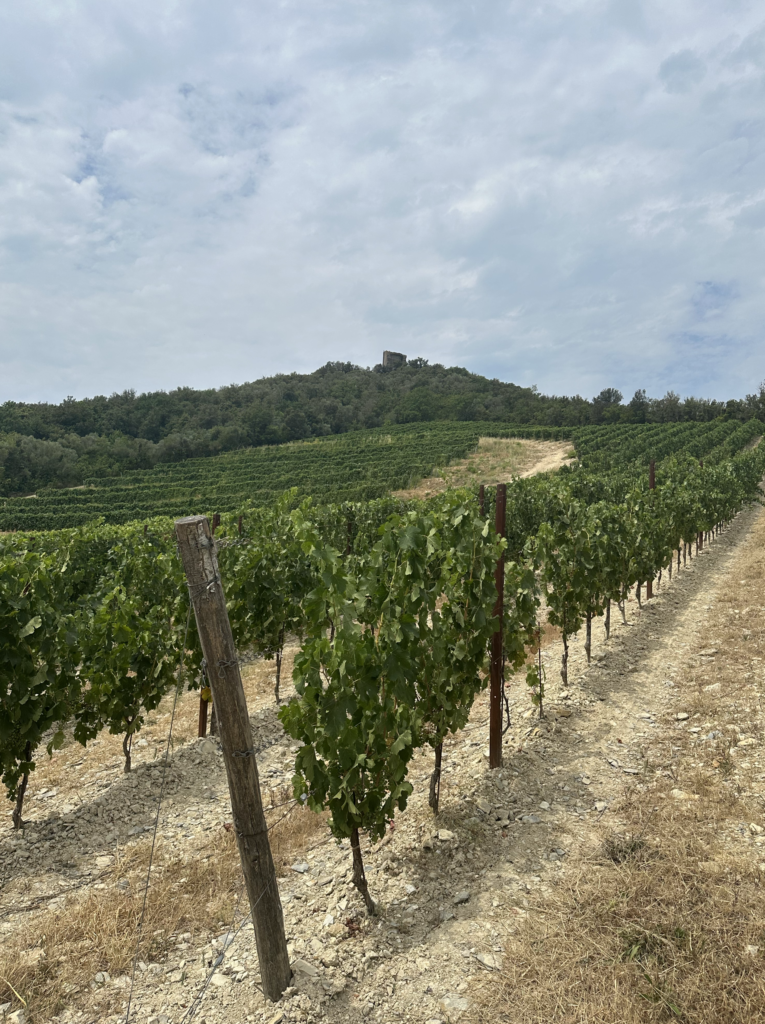
Most of the Bolgheri appellation lies on the plain between Bolgheri and Castagneto Carducci. Here, instead, the vineyards are on the hills, immersed in the Mediterranean scrub, with altitudes reaching around 300 metres above sea level, different exposures and extremely varied soils.
In an age of increasing drought and rising temperatures, the value of having hillside vineyards, well ventilated, with temperature shifts, slopes and such diverse geological matrices is enormous. Perhaps, for Bolgheri, almost priceless.
Cabernet Sauvignon, Cabernet Franc and Merlot are the main varieties, but the spirit is one of continuous research. The soils change: sand, limestone, schist, volcanic components. The analyses have made it possible to identify macro-areas and micro-terroirs, combinations of rootstocks, clones and nurseries designed to respond precisely to the characteristics of each parcel.
Thus, from the first vintage, 2021, the estate’s three wines were born: Clinio, Harte and Hortense. Three different interpretations, linked to three expressions of the soil architecture identified by Pedro Parra and its research.
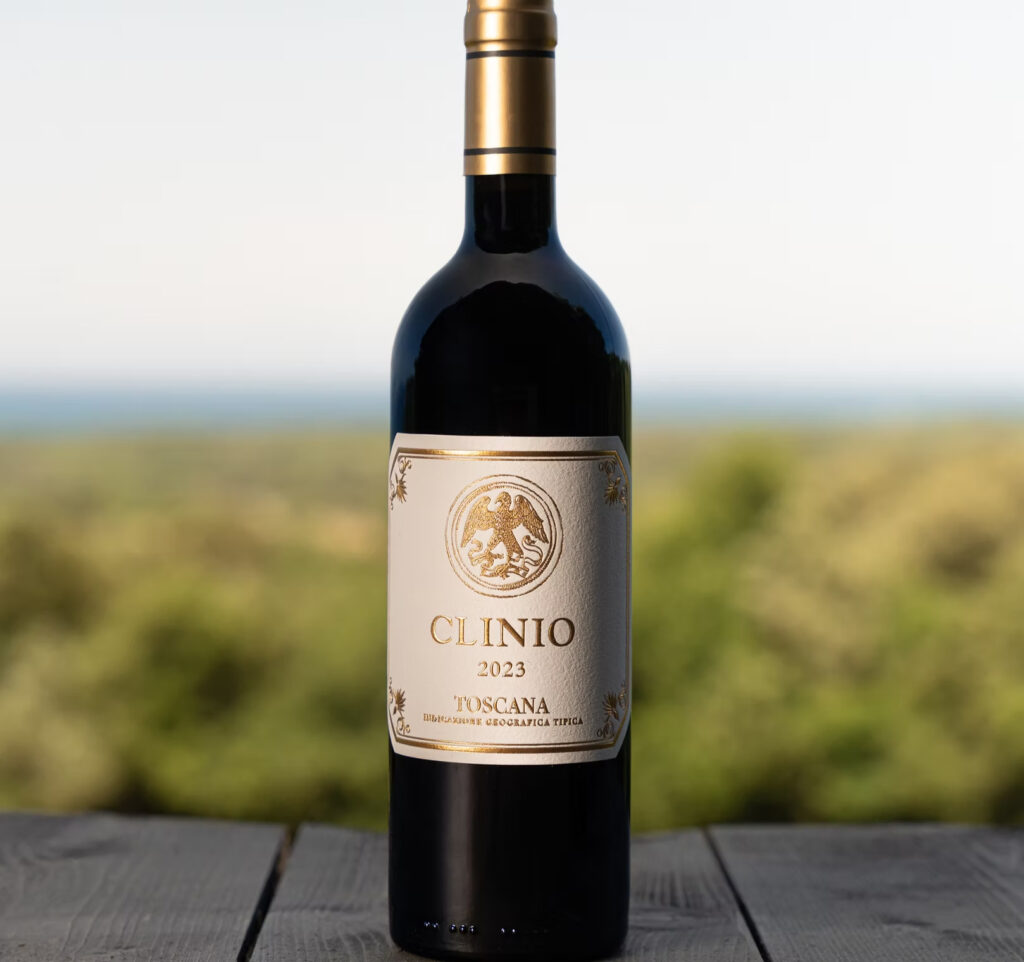
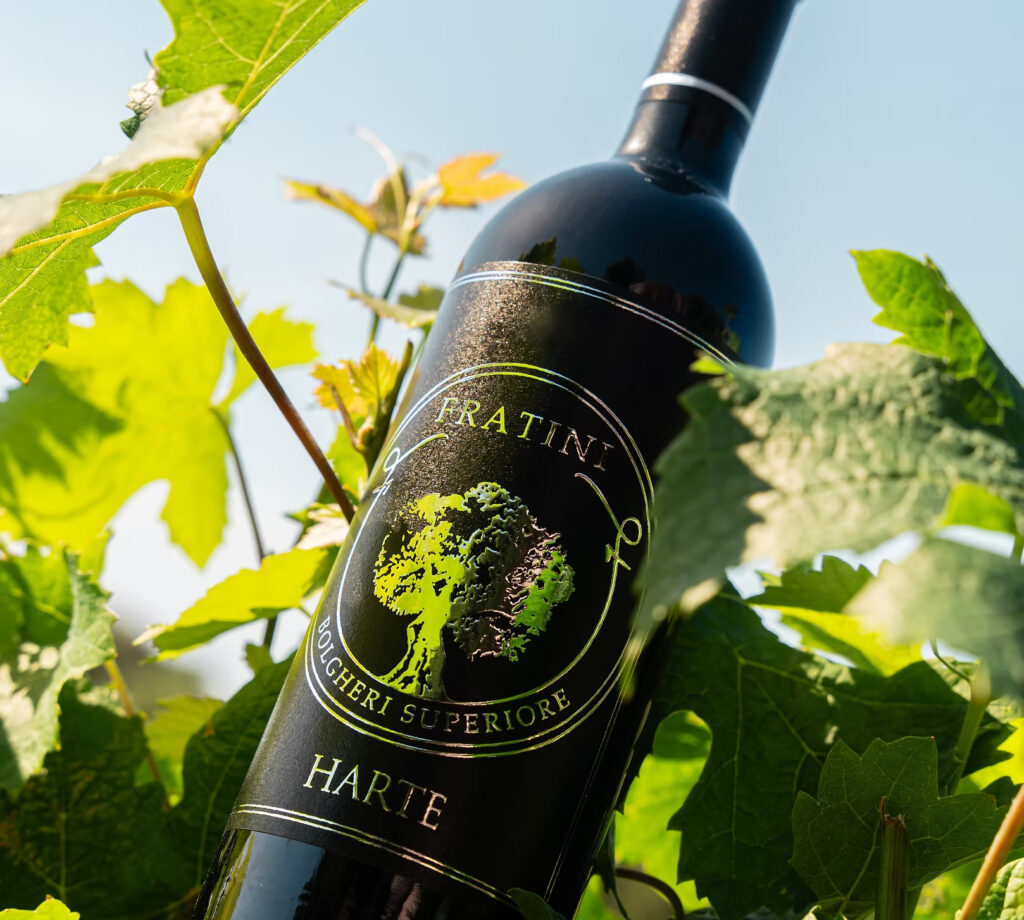
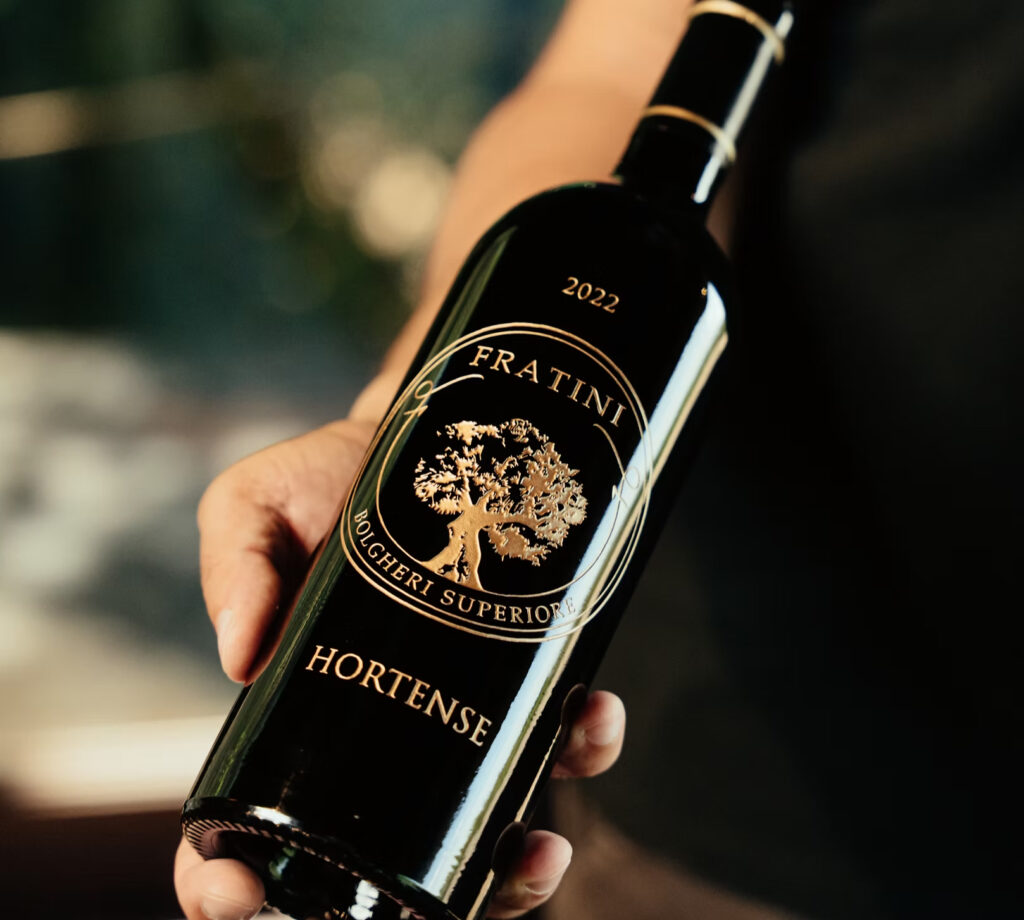
Writing about wine is always difficult. The best solution is always to taste. But what we can say is that here, knowledge of the territory translates into wines with structure, but also freshness. Deep, but vertical. With tannins that are present, but gentle, well integrated, never rough.
There is ripeness, of course. We are in Bolgheri. But there is also precision. And above all, there is balance between sugar ripeness and phenolic ripeness, between fruit and tannin, between warmth and drive.
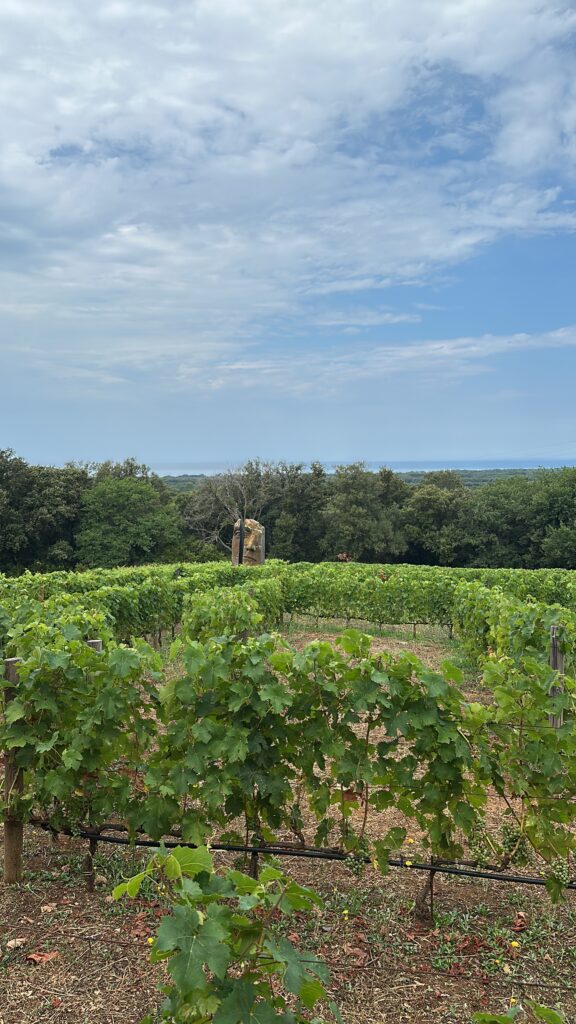
These are wines that speak of Mediterranean scrub, sea, light and hills. Warm and enveloping, but far from that sometimes excessive, opulent and demanding idea of Bolgheri. Here the substance is there, but it is guided. The power is there, but it never overwhelms. The hand is present, but it never covers the place.
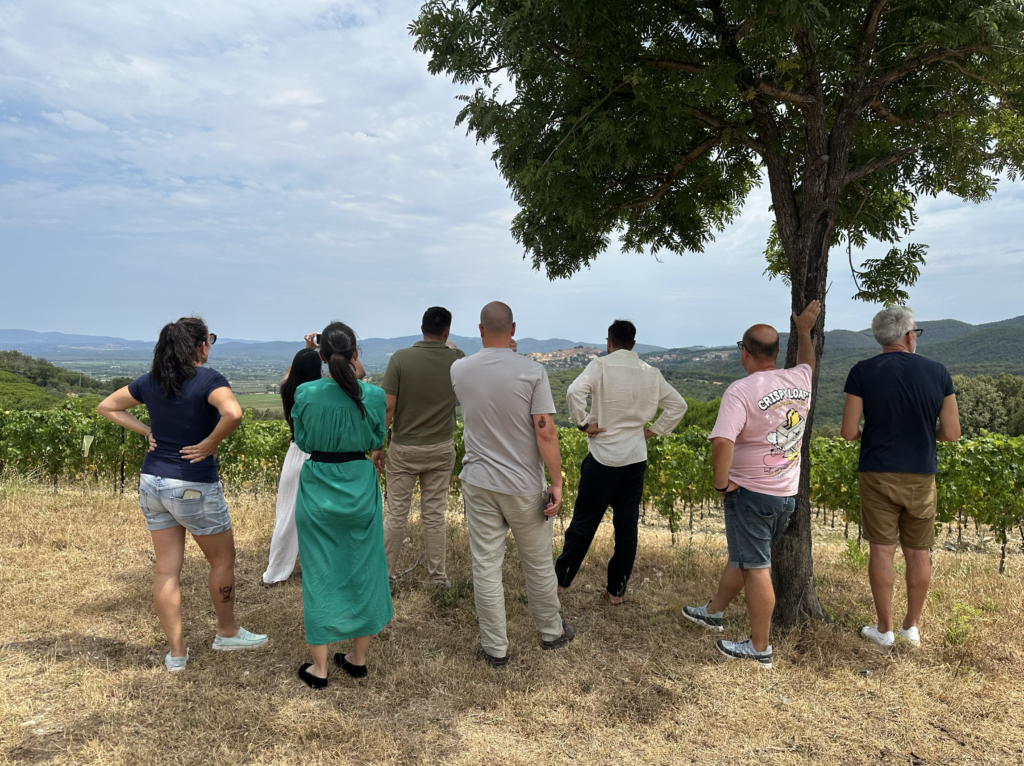
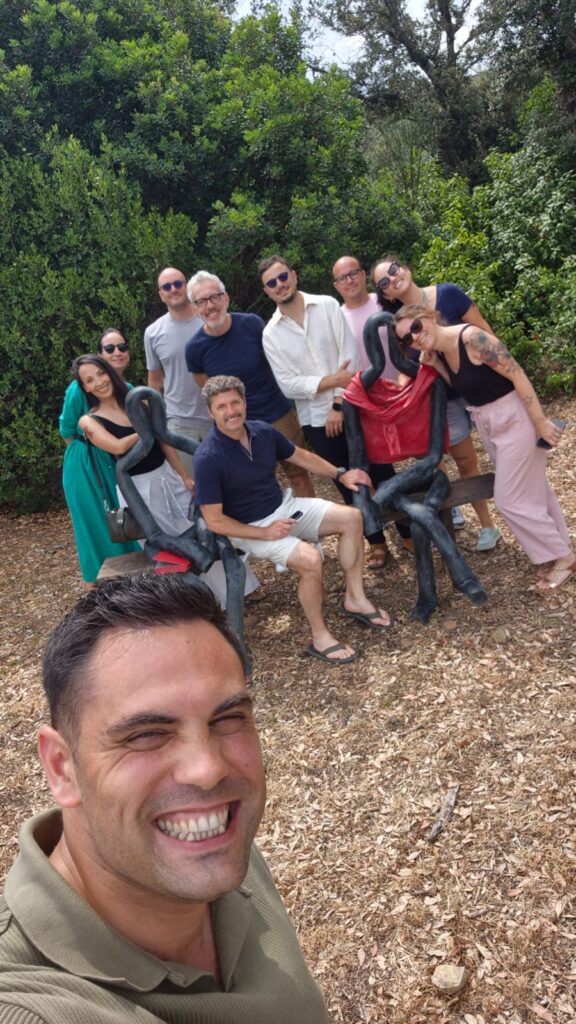
With Davide, we immersed ourselves in the world of Fratini for almost five hours. Among vineyards, stories, technical details, future visions, sea and hills. A visit that flew by and left a mark on the whole team.
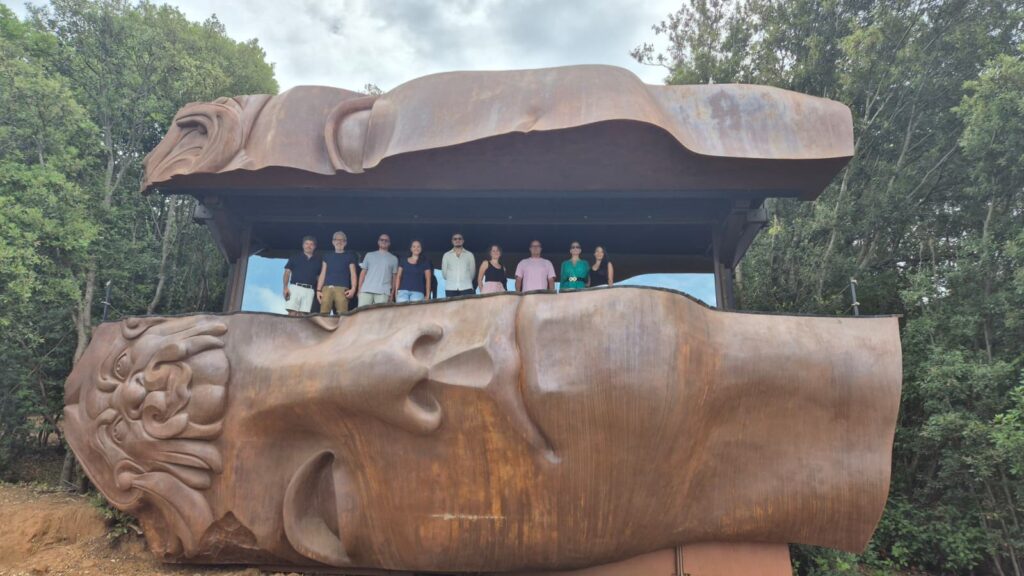
We left for home tired, of course. But above all motivated, inspired, happy. With the feeling of having written another small page in the recent history of Chronos.
Because in the end, Chronos is also this.
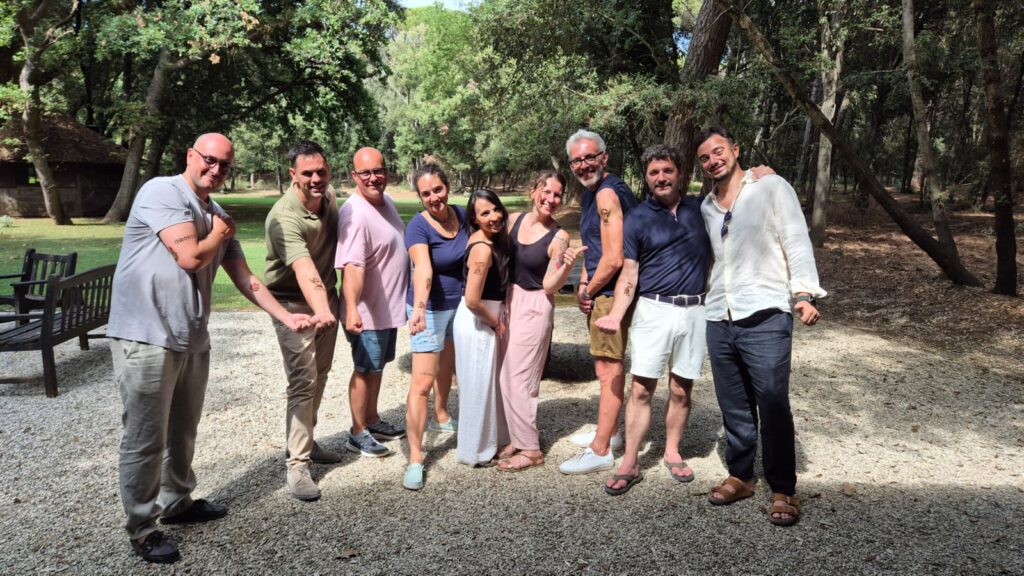
Leaving early. Covering kilometres. Going there. Seeing for ourselves. Listening to those who work the land. Understanding before telling. Valuing, down to the last kilometre, the quality work that begins with our winegrowing partners.
We have been trying to do this every day, for several years. Over time we become more aware, we improve, we define our path more clearly. It is not always easy, but that is precisely where the motivation comes from.
Professionalism, passion, knowledge, curiosity. But also groundedness and vision. Without frills.
Two days in Tuscany reminded us once again why we do this work. For the people, first of all. For the places. For real wines. For healthy projects, built to last. For that rare feeling that comes when quality, friendship and vision meet in the same glass.
And yes, also for those 48-hour journeys that seem small, but stay with you for a long time.